Páginas

Mostrando entradas con la etiqueta music theory. Mostrar todas las entradas

miércoles, 15 de febrero de 2017

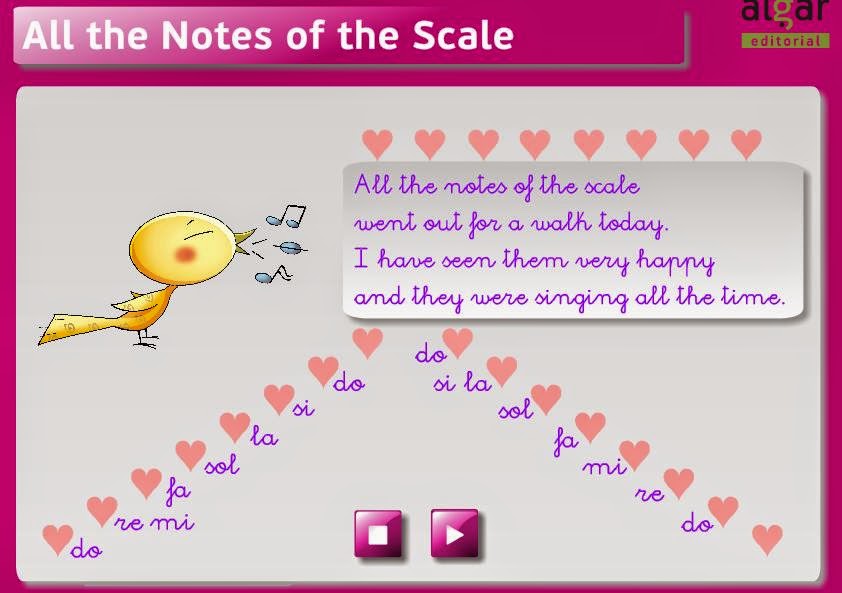
Learn the musical scale - Primary Education

There are many resources we can use to teach the musical scale:


C Major scale (Escala de Do Mayor)


A scale is a sequence of notes, ordered by pitch. A scale can be ascendig or descending.

The following activity comes from the webpage Bromera, which has a full range of digital activities in English.

http://www.bromera.com/tl_files/activitatsdigitals/andantino_1a_PF/eng_A1_05_Pulsacio_Totes_les_notes.swf


About how to teach the name of the notes, you can teach them using the American notation (A, B, C, D, E, F, G) or in Spanish.


Using the wall glockenspiel our students can learn how to sing the different notes of the scale and they can play them on the smart board:

http://www.bromera.com/tl_files/activitatsdigitals/andantino_1a_PF/eng_A1_24_Carillo_PDI.swf


lunes, 2 de marzo de 2015

THE DIATONIC SCALE


  • A scale is a set of notes ordered by pitch. It can be ascending or descending
  • The diatonic scale is made of seven notes (high 'do' is repeated)

  • It has five tones (or whole steps) and two semitones (or half steps)
  • The semitones in the diatonic scale are between the notes mi-fa and si-do

  • If you look at the keys of a piano you can see the distance of tone and semitone easily. There is no black key between the semitones.

sábado, 28 de febrero de 2015

INTERVALS


  •  In music, an interval is the difference between two notes.
  • An interval can be of: 
second (2nd), third (3rd), fourth (4th), fifth (5th), sixth (6th), seveth (7th), octave (8th) and so on.


  • Intervals can be ASCENDING or DESCENDING:


  •  An interval can also be HARMONIC or MELODIC.
Related Posts Plugin for WordPress, Blogger...