Download HERE some activities about the Classical period prepared to work in secondary education.

Mostrando entradas con la etiqueta AICLE. Mostrar todas las entradas
Mostrando entradas con la etiqueta AICLE. Mostrar todas las entradas
jueves, 15 de febrero de 2018

MUSICAL INSTRUMENTS FOR KIDS
Some videos to teach the musical instruments in primary school:
Fuente: Babyteacher and KidsLearningVideos
martes, 13 de febrero de 2018

sábado, 10 de febrero de 2018
THE WORLD OF CASTRATI - BAROQUE STYLE
The extraordinary adulation accorded to castrati during the XVIIth and XVIIIth centuries is still today one of the most fascinating phenomena in the history of music.
During this golden age of castrato, these male singers endowed with high voices that combined incredible refinement, amazing power and superhuman virtuosity, took the musical world by storm.
The whole of Europe was overcome by infatuation for these vocal prodigies, who whithin the space of a few years became the main reason foir attendig opera performances.
Today, despite the fact that they are no longer with us, the castrati continue to be the embodiment of that vocal perfection that was so frequently documented by their contemporaries. The evocation of these miruculous voices (which seem to come from another world) both disturbs and at the same time appeals to our modern sensibilities.
The story of the castrati is both charming and cruel. Charming because it blurs the boundaries between reality and fantasy and cruel because it exposes the intolerable violence that was perpretated in the pursuit of beauty:
"Some die, others acquire a voice more beautiful than that of a woman".

The castration of young singers was first practised in Western Europe in the XVIth century to supply women in some performances as they weren't able to participate in any musical performance. The practise soon became widespread in Italy. The young singers who showed signs of being particulary gifted were operated on before their voices had broken, in order to preserve their child's voice in all its purity.
Castrati had pure voices in which the high notes of a child's voice were supported by exceptionally powerful lungs.
Amongs the hundreds of castrati who were active in Europe between the XVIIth and XIXth centuries, only a handful of the most famous names still resonate today: Farinelli, Carestini, Nicolino, Senesino (Handel's favourite castrato) and Giovanni Manzoli.
The castrati started to dissapear around the end of the XVIIIth century onwards. Domenico Bedini, who sang Sesto in Mozart's "La clemenza di Tito" and Velluti were the last great stars. From about 1830 men with the voices of angels dissapeared from the stage.
This practise has gone for good, as in the XXIst century, there's no way that a practise that goes against the fundamental values of a society could be revived.
martes, 8 de agosto de 2017
Libros de texto CLIL- 2ª parte
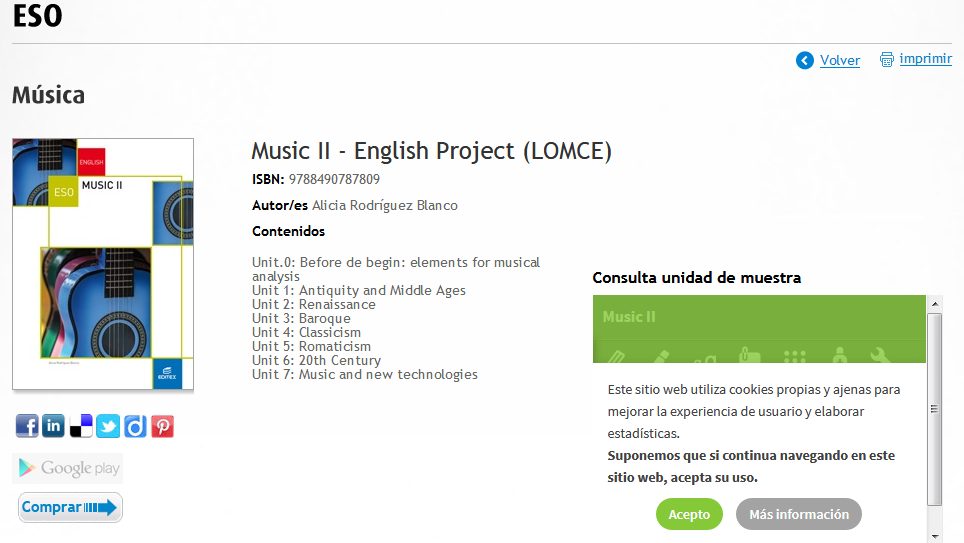
La editorial Editex tiene actualmente en su catálogo libros de texto para la ESO: Music I y Music II.


La editorial SM es una de las que más amplio catálogo presentan para Ed. Primaria:

Pearson tiene libros de texto CLIL tanto para Primaria como para Secundaria. En Primaria los proyectos 'Tarantella' y 'Feel the Music' y para la ESO 'Live Music' con dos volúmenes.


La editorial SM es una de las que más amplio catálogo presentan para Ed. Primaria:

Pearson tiene libros de texto CLIL tanto para Primaria como para Secundaria. En Primaria los proyectos 'Tarantella' y 'Feel the Music' y para la ESO 'Live Music' con dos volúmenes.

sábado, 5 de agosto de 2017
Descubre qué libros de texto te pueden ayudar
Casi todas las editoriales españolas han ido lanzando progresivamente distintos títulos dedicados a la educación bilingüe (CLIL/AICLE), tanto para Primaria como para educación Secundaria. A continuación os presenta una selección con algunos de ellos:
La editorial Anaya tiene disponible en su catálogo, bajo el proyecto para educación bilingüe 'Learning is growing', libros de texto tanto para primaria como para secundaria:
Anaya 'Learning is growing' for Primary and Secondary education education: Catálogo Primaria
Catálogo Secundaria


La editorial Edelvives, en colaboración con MacMillan Education presentan el proyecto ByME.
De momento para primaria solo tienen para los cursos 1º y 2º. Visita el catálogo.

Santillana ha presentado un variado catálogo dedicado a la educación bilingüe. Tiene libros de música para Primaria y Secundaria:
Visita su catálogo

Catálogo secundaria
La editorial Anaya tiene disponible en su catálogo, bajo el proyecto para educación bilingüe 'Learning is growing', libros de texto tanto para primaria como para secundaria:
Anaya 'Learning is growing' for Primary and Secondary education education: Catálogo Primaria
Catálogo Secundaria


La editorial Edelvives, en colaboración con MacMillan Education presentan el proyecto ByME.
De momento para primaria solo tienen para los cursos 1º y 2º. Visita el catálogo.

Santillana ha presentado un variado catálogo dedicado a la educación bilingüe. Tiene libros de música para Primaria y Secundaria:
Visita su catálogo

Catálogo secundaria
Suscribirse a:
Entradas (Atom)
